Wrinkles in clothing are an unwelcome sight, whether you’re preparing for a crucial business meeting or simply aiming for a polished everyday look. For decades, the traditional iron was the go-to solution, but the advent of standing garment steamers revolutionized how we approach fabric care. Among the most respected names in the industry, Jiffy Steamer stands out, offering robust and reliable units. Two of their most popular models, the J-2000 and the J-4000, often leave prospective buyers wondering which is the right fit. This comprehensive guide will dissect the nuances of each model, helping you make an informed decision tailored to your specific needs.
What is a Standing Garment Steamer?
A standing garment steamer is an appliance designed to remove wrinkles from fabrics using a continuous flow of steam. Unlike traditional irons that rely on direct heat and pressure, steamers gently relax fabric fibers, making them ideal for delicate materials like silk, satin, and even heavily embellished garments that an iron might damage. These devices typically consist of a water reservoir, a heating element, a hose, and a nozzle, allowing for quick and efficient wrinkle removal without the need for an ironing board. Their primary advantages include speed, safety for a wider range of fabrics, and the ability to refresh clothes by eliminating odors.
Understanding the Jiffy Steamer Legacy
Jiffy Steamer has built a formidable reputation over the years, becoming synonymous with quality, durability, and consistent performance in garment care. Their steamers are celebrated for their robust construction and ability to withstand rigorous use, making them a staple in both residential settings and demanding commercial environments. The brand’s commitment to reliability has cemented its position as a trusted choice for professionals and home users alike. The J-2000 is widely recognized for its convenience and efficiency in home and light commercial applications, while the J-4000 is engineered as a heavy-duty workhorse for sustained, intensive steaming tasks.
Jiffy J-2000 vs. J-4000: A Detailed Comparison
Deciding between the Jiffy J-2000 and J-4000 requires a close look at their core differences. While both deliver exceptional results, their design, power, capacity, and features cater to distinct user profiles and steaming demands.
Design and Construction
|
Our Picks for the Best Standing garment steamer in 2026
As an Amazon Associate I earn from qualifying purchases.
|
||
| Num | Product | Action |
|---|---|---|
| 1 | SALAV GS18 Full-Size Clothes Steamer - 1500W Power, 1.8L Water Tank, 60-Min Garment Steam, Iron Clothing, Adjustable Pole & Wheels for Easy Storage, Professional Standing Steamer for Clothes, White |

|
| 2 | Jiffy Steamer J-2000 Jiffy Garment Steamer with Plastic Steam Head, 120 Volt, Beige |
|
| 3 | SALAV® Heavy Duty Smart Auto Shut-off Commercial Full-Size Garment Steamer, Beeping Alert when Water Runs out, Foot Pedal Control, XL 3L (101.5 oz) Tank, 1800 watts, 90+min of Continuous Steam, Navy |
|
| 4 | Upright Steamer for Clothes 1350W Turbo Boiler Standing Garment Steamer 1.6L Water Tank 1h Continuous Steam Flat&Hanging Ironing Double Retractable Rod 10 Modes 30s Fast Preheat for all Fabrics |
|
| 5 | SALAV Heavy Duty Commercial Full-Size Garment Steamer with Foot Pedals and Extra Large 3L (101.5 oz) Water Tank, 1800 watts, 90+min of Continuous Steam (White) |
|
| 6 | True & Tidy Heavy Duty Commercial Full Size Standing Garment Steamer for Clothes with Extra Large 3L (101 oz) Water Tank for 90+ mins of Steam Time, 1800 watts of Powerful Steam, 3 Settings, Gray |
|
| 7 | SALAV GS18-DJ Standing Garment Steamer with Roll Wheels for Easy Movement, 1.8L Water Tank for 1 Hour Continuous Steaming, Adjustable Pole for Storage, Includes Descaler Packet, 1500 watts |
|
| 8 | Garment Steamer for Clothes Standing, 1500W Efficient Clothes Steamer Standing with Wheels, Professional 58OZ Water Tank for Continuous Steaming, Fast Heating Wrinkle Remover |
|
| 9 | Pure Enrichment PureSteam XL Standing Fabric Steamer - Professional Wrinkle Remover Heats in 45 Seconds; 1/2-Gallon Tank for 1 Hour of Steaming; Easy-Roll Wheels, Garment Hanger, & Fabric Brush |
|
| 10 | SALAV Heavy Duty Commercial Full-Size Garment Steamer with Foot Pedals and Extra Large 3L (101.5 oz) Water Tank, 1800 watts of Poweful Steam (Navy) |
|
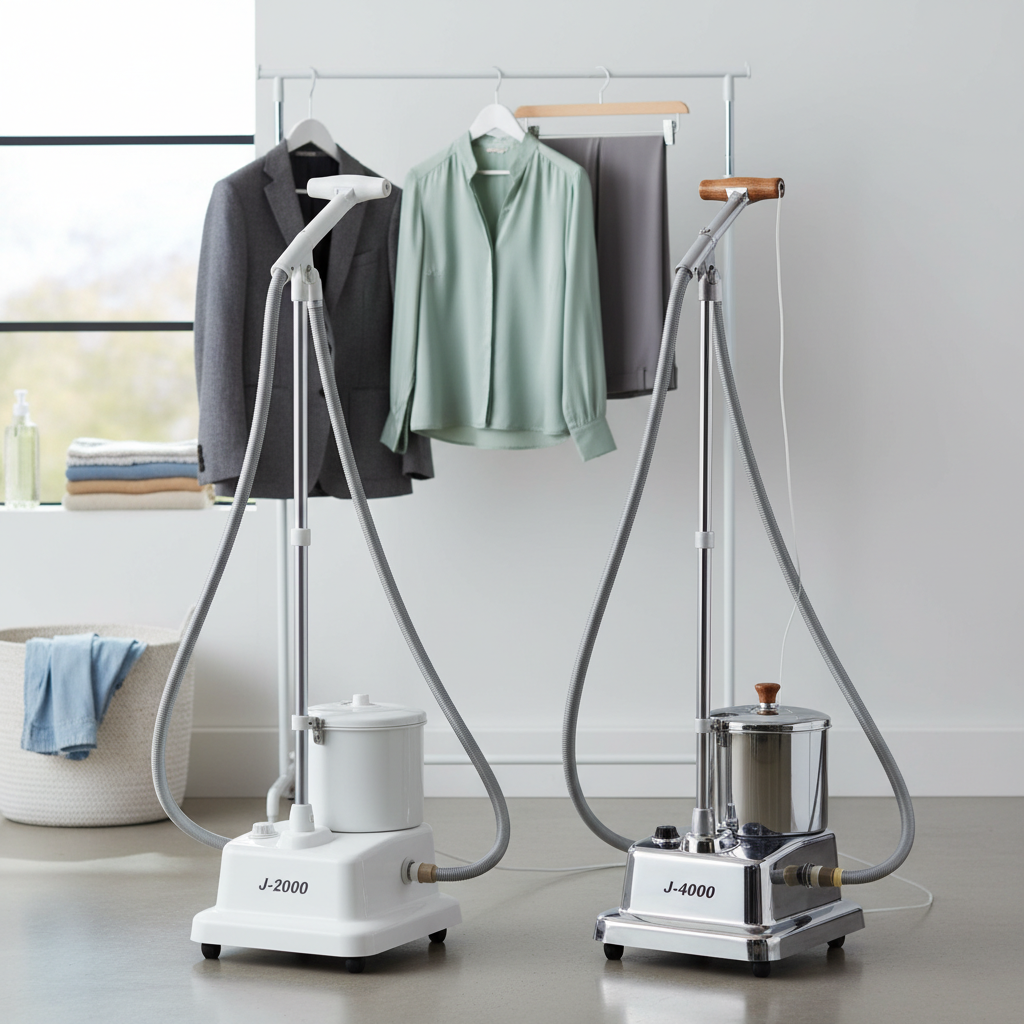
The physical build of a steamer significantly impacts its durability and suitability for various environments. The J-2000 features a compact and lightweight design, largely attributed to its high-impact plastic body. This makes it easily maneuverable and convenient for storage in smaller spaces. In contrast, the J-4000 boasts a more robust construction, incorporating metal components, often die-cast aluminum. This heavier, more industrial build lends itself to greater durability, making it well-suited for frequent and demanding use in commercial settings where resilience is paramount.
Power and Performance
The wattage and steam output are critical indicators of a steamer’s effectiveness, especially when dealing with different fabric types. The J-2000 operates with a 1300-watt heating element, allowing it to heat up quickly, typically within 2 to 3 minutes. It produces a consistent steam flow that is highly effective for lightweight to medium-weight fabrics, such as cotton shirts, dresses, and everyday garments.
The J-4000, with its more powerful 1500-watt heating element, takes slightly longer to reach its optimal steam temperature, often ranging from 3 to 20 minutes depending on the source and specific model variant. However, once heated, it delivers a significantly more powerful and sustained steam burst, generating approximately 15% more steam flow than the J-2000. This makes the J-4000 exceptionally efficient for heavy fabrics like upholstery, drapes, denim, and suits, effortlessly tackling deep-set wrinkles that lighter steamers might struggle with.
Water Capacity and Continuous Steaming
The water reservoir’s capacity dictates how long a steamer can operate continuously before needing a refill, a crucial factor for both convenience and productivity. The J-2000 typically comes with a water tank capacity ranging from 0.75 gallons (3/4 gallon) to 1 gallon. This provides a continuous steaming time of approximately 45 to 100 minutes, depending on the specific model and steam head configuration. A notable convenience of the J-2000 is its detachable tank, which makes refilling a simple process that can be done at any standard sink.
The J-4000 features a larger water reservoir, generally between 1 to 1.5 gallons, though some commercial variants may accommodate up to 3 gallons. This expanded capacity allows for extended periods of continuous steaming, often lasting from 75 minutes up to 2 hours or more on a single fill. Unlike the J-2000, the J-4000’s tank is usually not detachable. Refilling typically requires using a water jug and a funnel, which, while effective, adds a minor step to the process compared to its smaller sibling.
Features and Usability
Beyond core performance, subtle features can greatly impact a steamer’s usability. The J-2000 offers a straightforward “on/off” operation, emphasizing simplicity and ease of use for quick steaming tasks. Its 5.5 to 6-foot hose provides adequate reach for most garments and household items.
The J-4000, designed for more intensive applications, often includes a “standby” setting. This feature is particularly valuable in commercial environments where the steamer needs to be ready for continuous use throughout the day without having to fully reheat. The J-4000 also comes with a longer 9-foot hose, offering greater flexibility and reach for larger items like drapes or extensive garment racks, reducing the need to reposition the unit.
Price Point
Generally, the J-2000 is the more affordable option, making it an attractive investment for home users and small businesses seeking professional results without a significant upfront cost. The J-4000, with its enhanced power, larger capacity, and more robust construction, represents a higher investment. This difference in price reflects its commercial-grade capabilities and superior durability for heavy-duty applications.
Comparison Table: Jiffy J-2000 vs. J-4000
| Feature | Jiffy J-2000 | Jiffy J-4000 |
|---|---|---|
| Primary Use | Home, Small-Medium Business | Commercial, Heavy-Duty |
| Wattage | 1300W | 1500W |
| Heat-up Time | ~2-3 minutes | ~3-20 minutes (varies by source/model) |
| Steam Output | Consistent, good for light-medium fabrics | Powerful, ~15% more, ideal for heavy fabrics |
| Water Capacity | 0.75 – 1 Gallon | 1 – 1.5 Gallons (some models up to 3 Gallons) |
| Continuous Steam | 45-100 minutes (varies) | 75-120 minutes or 2+ hours |
| Construction | High-impact Plastic Body | Metal Components, Robust |
| Portability | More Portable, Lightweight | Less Portable, Heavier |
| Tank Filling | Detachable, easy to fill in sink | Non-detachable, requires jug/funnel |
| Hose Length | 5.5 – 6 feet | 9 feet |
| Controls | On/Off | On/Off, Standby Setting |
| Price | More Affordable | Higher Investment |
Choosing the Right Jiffy Steamer for Your Needs
Selecting between the J-2000 and J-4000 ultimately depends on your specific steaming requirements, frequency of use, and the types of fabrics you’ll primarily be working with. Each model excels in different scenarios, making them tailored for distinct user experiences.
For Home Users and Small Businesses
If your needs revolve around daily garment touch-ups, refreshing a few outfits, or managing light to medium fabric loads, the Jiffy J-2000 is often the ideal choice. Its rapid heat-up time means you can get steaming almost immediately, perfect for busy mornings. The lighter weight and compact design also ensure it’s easy to store and move around your home or a boutique setting. For those who prioritize quick use, portability, and straightforward operation, the J-2000 delivers excellent performance without being an overkill.
For Commercial and Heavy-Duty Applications
For users in commercial environments such as fashion showrooms, dry cleaners, bridal shops, or even avid home users with extensive wardrobe care needs, the Jiffy J-4000 is the superior investment. Its powerful, sustained steam output is designed to handle large volumes of garments, heavy drapes, or thick upholstery with ease and efficiency. The larger water capacity and the standby setting are invaluable for continuous steaming throughout the day, ensuring the machine is always ready. When robust performance, extended operation, and unwavering durability are top priorities, the J-4000 is built to meet those demanding requirements.
Budget Considerations
Your budget naturally plays a role in this decision. The J-2000 offers a more accessible entry point into high-quality garment steaming, providing significant value for its price. If you’re looking for professional-grade results for everyday use without a substantial investment, it’s an excellent option. The J-4000, while more expensive, justifies its cost through its enhanced power, capacity, and longevity in heavy-use scenarios. Consider it an investment that pays off in reliability and performance for commercial or high-volume personal use.
Maximizing the Lifespan of Your Jiffy Steamer
To ensure your Jiffy J-2000 or J-4000 continues to perform optimally for years, proper usage and diligent maintenance are key. These units are built for durability, but a little care goes a long way in preserving their efficiency and extending their lifespan.
Usage Tips for Optimal Results
Always allow your steamer to fully preheat before use. For the J-2000, this is typically a couple of minutes; for the J-4000, ensure sufficient time for it to build up its powerful steam, especially if you’re tackling tougher fabrics. When steaming, work from the underside of the fabric to push wrinkles out more effectively, and hold the garment taut to create a smooth surface. While Jiffy steamers are designed to use ordinary tap water, using distilled or demineralized water can help minimize mineral buildup, particularly in areas with hard water, thereby prolonging the life of the heating element.
Maintenance and Troubleshooting
Regular descaling is paramount for any steamer. Over time, mineral deposits from water can accumulate, affecting performance and potentially damaging the unit. A common maintenance practice is to periodically flush the water reservoir with a solution of white vinegar and water (e.g., a 50/50 mix), allowing it to sit for a while before draining and rinsing thoroughly. This helps break down mineral buildup. For specific descaling instructions, always refer to your model’s user manual.
Common issues like reduced steam output or spitting are often related to mineral buildup or an improperly filled tank. If you experience these, a good descaling and ensuring the water level is adequate can often resolve the problem. Always ensure the hose is free from kinks during operation, as this can impede steam flow.
Expert Insights on Jiffy Steamers
“Jiffy steamers have set the benchmark for garment care. Their robust construction and consistent performance make them a true investment for both home and professional use.”
Conclusion
The choice between the Jiffy J-2000 and J-4000 boils down to understanding your specific garment care needs. The J-2000 is a fantastic, quick-heating, and portable option perfect for everyday home use and light commercial tasks, offering excellent performance and convenience. The J-4000, on the other hand, is an industrial-grade powerhouse, designed for continuous, heavy-duty steaming of large volumes and tough fabrics in demanding professional environments. Both models uphold Jiffy’s legacy of quality, ensuring your garments are always impeccably smooth and fresh. By evaluating their differences in power, capacity, and features against your requirements, you can confidently select the Jiffy steamer that will best serve you for years to come. What kind of fabrics dominate your wardrobe, and how frequently do you find yourself reaching for a wrinkle solution?
Frequently Asked Questions
Can I use tap water in a Jiffy steamer?
Yes, Jiffy steamers are generally designed to use ordinary tap water. However, if you live in an area with particularly hard water, using distilled or demineralized water can help prevent mineral buildup and extend the life of your steamer.
How often should I descale my Jiffy steamer?
The frequency of descaling depends on your water hardness and how often you use the steamer. For regular use with hard water, descaling once every few months is recommended. With softer water or less frequent use, once or twice a year may suffice. Always refer to your user manual for specific guidance.
What’s the difference between a garment steamer and an iron?
A garment steamer uses steam to relax fabric fibers and remove wrinkles, ideal for delicate fabrics and quick touch-ups. An iron uses heat and pressure to flatten wrinkles, suitable for crisp finishes and heavier fabrics, but can damage delicate materials.
Can Jiffy steamers be used for upholstery?
Yes, both the Jiffy J-2000 and J-4000 can be effectively used for steaming upholstery, curtains, and drapes. The J-4000, with its more powerful steam output and longer hose, is particularly well-suited for larger, heavier upholstery projects and continuous use.